
Ultra Processed Food (UPF)
What does the NOVA classification mean for your strategic choices?
Ultra-processed food dominates the debate around health and nutrition. Media often link the term directly to “unhealthy”, while retailers, QSR chains and food manufacturers must make strategic decisions about assortment, formulation and positioning. At the same time, many plant-based products fall within the UPF category. That makes nuance essential.
The key question is not whether a product is processed, but what that processing means for nutritional value, taste, texture, price and consumer perception. In this blog, we translate the insights from this presentation into concrete considerations for your decisions.
Is UPF unhealthy or not? What does the NOVA classification say?
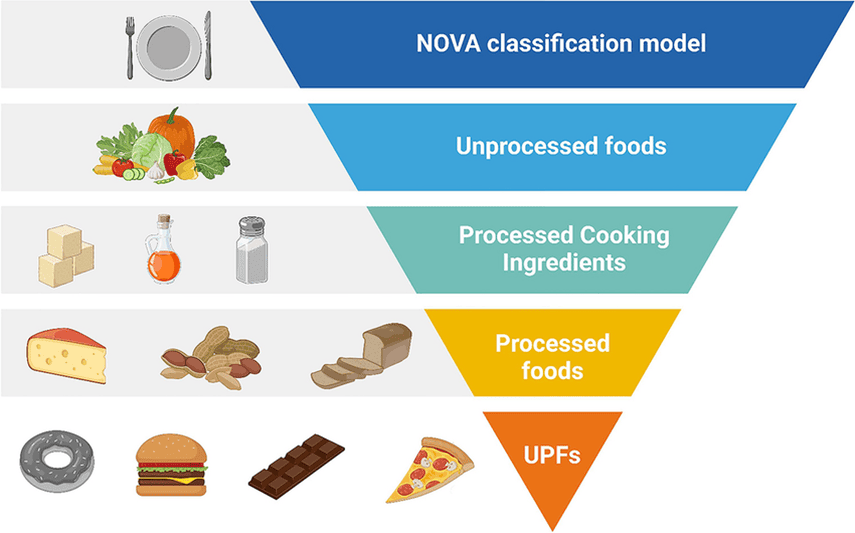
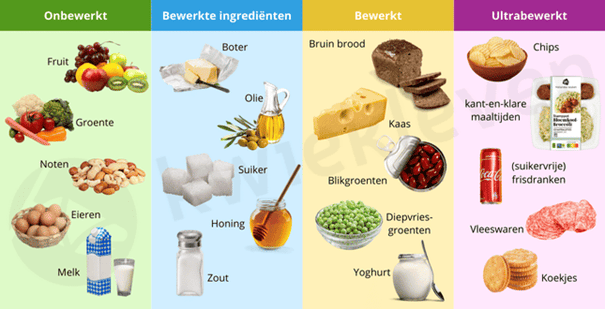
The NOVA classification groups foods based on their level of processing. Ultra-processed foods (NOVA 4) are industrially produced, contain multiple ingredients and undergo several processing steps. The NOVA 4 category includes a wide range of products, from soft drinks and hot dogs to meat alternatives. The classification therefore describes the process, not automatically the nutritional quality.
Why the Ultra-Processed Food debate is becoming distorted
Media and influencers often equate “ultra-processed” with “unhealthy.” Research (2024) shows that many Europeans perceive meat alternatives as ultra-processed, including tofu, tempeh and seitan. As a result, about half avoid these products. However, the negative health effects associated with UPF are mainly linked to products such as soft drinks, confectionery and processed meat. This distinction often disappears in the public debate. One study shows that:
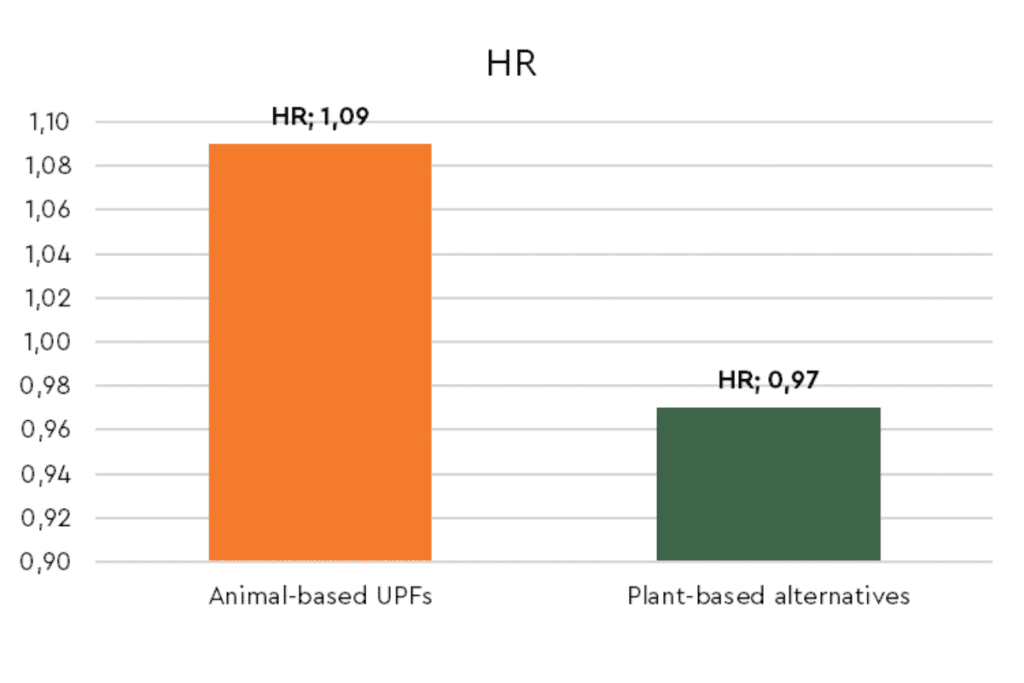
- Consumption of animal-based UPFs → HR 1.09
- Plant-based alternatives → HR 0.97
This means there is no clear indication that plant-based ultra-processed products carry the same health risk profile.
What is an HR (Hazard Ratio)?
An HR (hazard ratio) indicates how large the risk is compared with people who consume little of that type of food.
- HR = 1 → same risk
- HR > 1 → higher risk
- HR < 1 → lower risk
he table below shows different types of ultra-processed foods. It indicates whether people who consume more of a specific type have a higher or lower likelihood of developing cancer or cardiovascular disease. If the entire number in parentheses lies above 1, the increased risk is likely statistically significant. 95% CI (in parentheses) indicates how certain researchers are about the estimate.
Animal-based products → HR = 1.09
➤ People who consume more of these products have a 9% higher risk of disease.
Plant-based alternatives → HR = 0.97
➤ No increased risk, possibly even slightly lower.
| Subgroup | HR (95% CI) | Interpretation |
|---|---|---|
| Ultra-processed grains & bread | 0.97 (0.94–1.00) | No increased risk, possibly slightly lower |
| Plant-based alternatives | 0.97 (0.91–1.02) | No increased risk, possibly slightly lower |
| Confectionery & desserts | 0.99 (0.95–1.03) | No increased risk |
| Savory snacks | 1.00 (0.96–1.04) | No increased risk |
| Other UPFs | 1.01 (0.97–1.05) | No clearly increased risk |
| Ready meals | 1.01 (0.98–1.04) | No clearly increased risk |
| Sauces, spreads, seasonings | 1.03 (1.00–1.06) | Slightly increased risk |
| Animal-based products | 1.09 (1.05–1.12) | Clearly increased risk |
| Sugar-sweetened beverages (incl. diet) | 1.09 (1.06–1.12) | Clearly increased risk |
| Total UPF intake | 1.09 (1.05–1.12) | Higher risk with higher consumption |
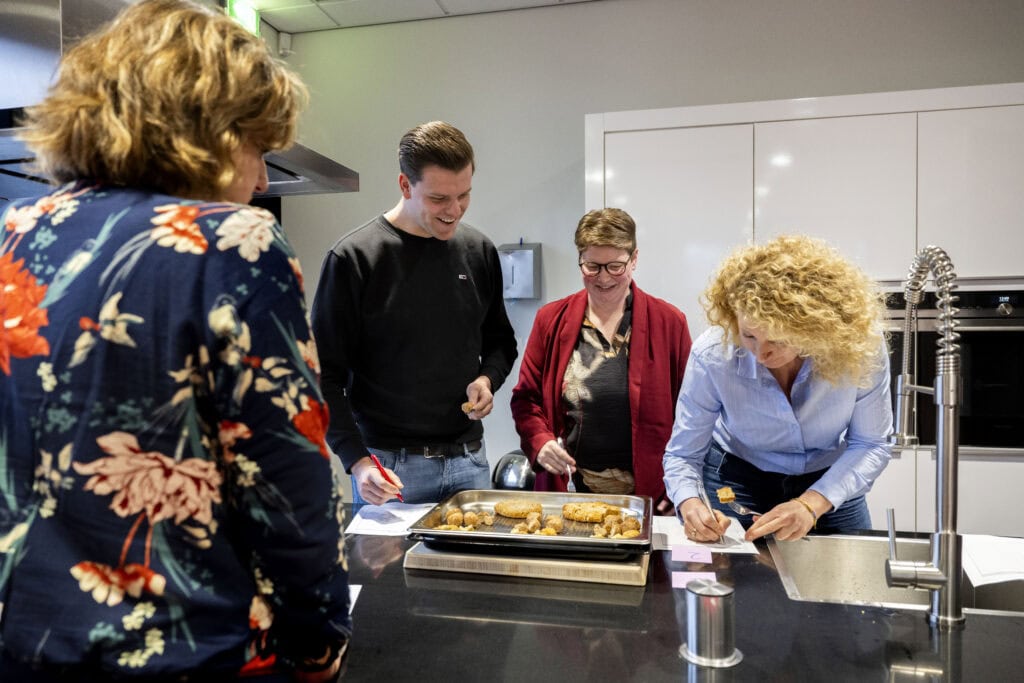
Processing does not say everything about health
Health depends on several factors:
- Nutritional values (sugar, salt, saturated fat, fibre, protein)
- Ingredient composition
- Portion size
- Consumption frequency
- Overall dietary pattern
UPF is therefore a classification and does not automatically imply a value judgement about health.
The impact of the UPF frame on decision-making
The way consumers perceive ultra-processed food directly influences purchasing behaviour, menu choices and product development. When UPF automatically becomes synonymous with “unhealthy,” it affects product rotation in retail, reputation in QSR and positioning in the food industry. Making assortment decisions based solely on the NOVA classification lacks nuance; focusing on nutritional profile provides clearer guidance.

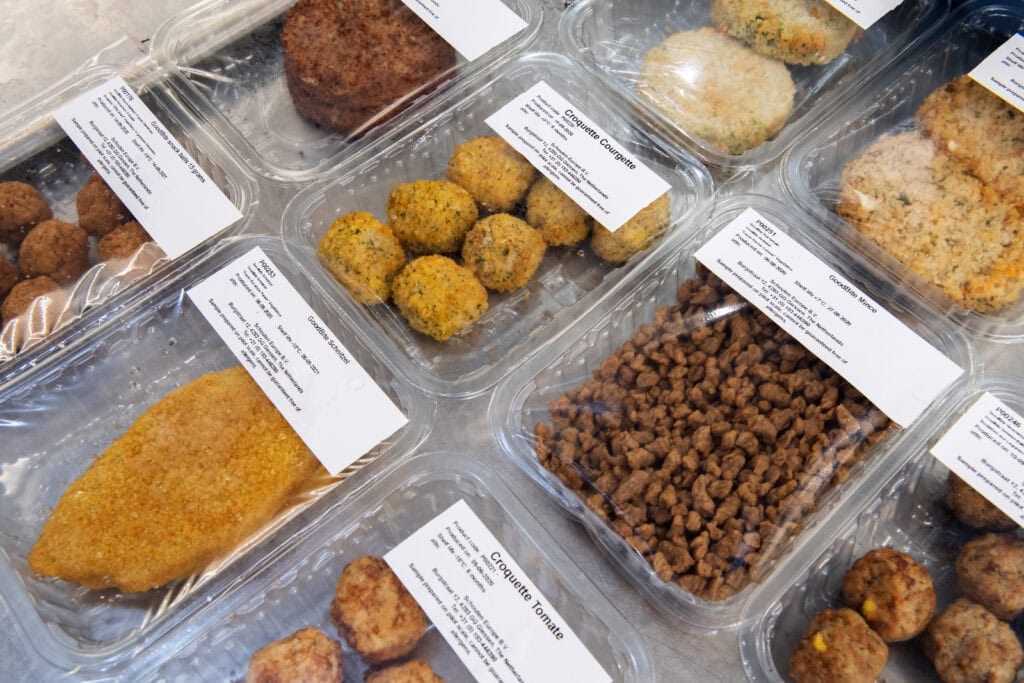
The composition of your protein portfolio
In many European countries, meat consumption exceeds dietary recommendations. At the same time, demand for alternatives that align with health and sustainability goals is growing. This increases attention on the composition of protein portfolios.
The UPF debate adds another dimension to this discussion. The value of a product is not determined solely by its level of processing, but by its nutritional profile and its role within the overall menu. Claims should therefore be supported by nutritional values, not by the NOVA classification alone.
Balancing priorities in product development
Third- and fourth-generation meat alternatives (see box: generations of meat alternatives) are classified as ultra-processed due to protein processing and the use of multiple ingredients. Yet these very processing steps enable the structure and functionality that make such products viable in real applications. This requires careful trade-offs in formulation and positioning. Fewer ingredients or functional performance? Clean label or texture? Perception or nutritional profile? This is where the strategic choice lies.

Generations of meat alternatives
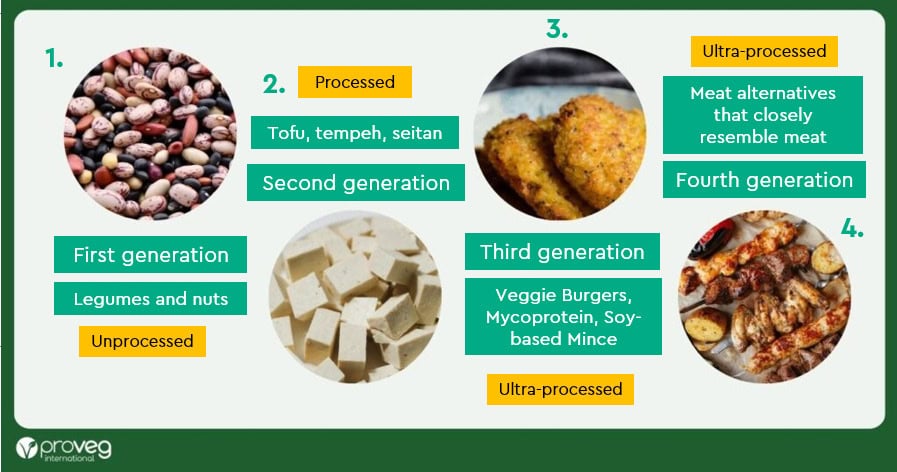
The first generation of meat alternatives is minimally processed and includes legumes and nuts.
The second generation consists of products made from the same ingredients as the first generation but processed into foods such as tofu, tempeh and seitan.
Third– and fourth-generation meat alternatives are classified as “ultra-processed” because the proteins used undergo processing before production and the final products contain multiple ingredients.
The question is: do you accept a higher level of processing if the nutritional value is right and the product performs well?
What does the UPF debate mean for your product and assortment decisions?
When is NOVA leading?
NOVA provides insight into the level of processing of a product. For assessing health impact, nutritional composition offers more meaningful guidance.

What carries more weight?
If health is the primary objective, the nutritional profile should take priority. If consumer perception and media impact are leading factors, the NOVA label may play a greater role.

How do you balance taste, texture and label?
Later generations of plant-based products fall into the ultra-processed category. This processing enables the meat-like structure that many applications require. The key question for decision-makers is: do you choose a higher level of processing if the nutritional value is right and the product performs well?
The UPF debate simplifies a complex issue. Strong decisions are not made by looking at the label alone, but by taking a balanced approach in which:
- Nutritional value is assessed explicitly
- Consumer perception is understood
- The product’s application in the menu or end product is taken into account
Would you like to learn more or explore solutions for your portfolio? Feel free to contact us using the contact form below.