What drives plant-based choices in Europe? 9 insights for the food industry
The European plant-based market is changing. Some countries are seeing growth, while others face declining sales volumes. At the same time, consumer expectations around taste, price, nutrition and convenience remain important. What does this mean for food manufacturers, retailers, foodservice providers and QSR chains?
In our latest European Consumer Insights, Schouten Europe brings together nine insights from European market data and consumer research. We explore how plant-based purchasing differs across countries, what encourages consumers to choose plant-based alternatives and where opportunities for product innovation lie.
The findings draw on research from GFI Europe/Circana, Smart Protein/ProVeg International and EIT Food. Schouten translates these insights into practical considerations for product development, assortment strategy and menu innovation.
1. Plant-based meat follows different paths across Europe
There is no single European growth story for plant-based meat.
According to GFI Europe/Circana, retail sales volumes increased by 16.8% in France and 4.1% in Italy between 2024 and 2025. Meanwhile, volumes declined in Germany (-1.7%), Spain (-7.0%), the United Kingdom (-9.4%) and the Netherlands (-10.7%).
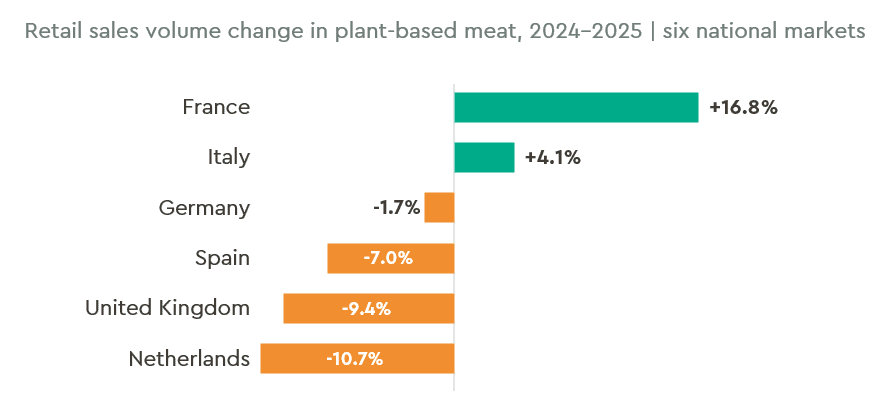
These differences highlight the importance of looking beyond Europe-wide trends. A product concept that fits one market may face different challenges in another.
Lower retail sales volumes also do not necessarily mean fewer consumers are purchasing plant-based products. Shoppers may simply be buying smaller quantities.
What does this mean for your business?
Start with the market you want to serve. Analyse local category performance, consumer expectations and distribution channels before developing or launching a product.
The opportunity lies in understanding each market rather than applying one strategy across Europe
2. Trying plant-based is not the same as buying it regularly
Attracting consumers to a product is one challenge. Encouraging them to buy it again is another.
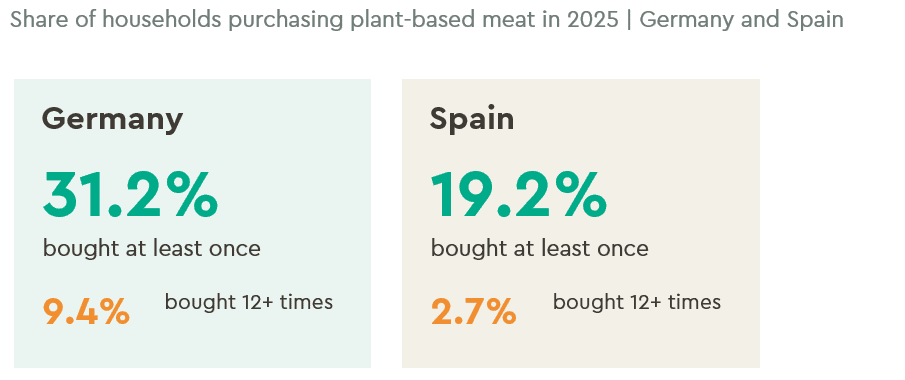
In Germany, 31.2% of households purchased plant-based meat at least once in 2025. However, only 9.4% purchased it 12 times or more.
In Spain, 19.2% of households made at least one purchase, while 2.7% purchased plant-based meat at least 12 times.
These figures show that reaching shoppers and encouraging repeat purchases are different objectives. Buying 12 times in a year does not necessarily mean buying every month.
What does this mean for your business?
A successful product introduction should extend beyond generating trial. Consider how your product earns a place in consumers’ regular eating routines. Taste, ease of preparation and versatility across different recipes are important considerations when developing products for repeat purchase.
A product should not only attract attention. It should give consumers a reason to choose it again.
3. Taste leads the plant-based purchase decision
What matters most when consumers select plant-based alternatives?
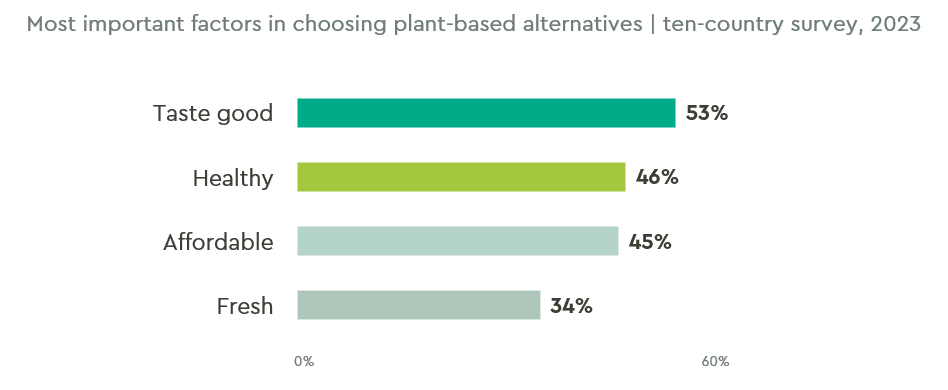
According to the 2023 Smart Protein European Consumer Survey, 53% of respondents selected good taste as an important factor. Health followed at 46%, affordability at 45% and freshness at 34%.
Environmental impact was selected by 21% of respondents.
The results suggest that, although environmental considerations matter to some consumers, the immediate product experience remains highly relevant.
What does this mean for your business?
Put taste and eating experience at the centre of product development and communication. Show consumers what makes a product appealing: flavour, texture, bite and the dishes they can prepare with it. Communicate nutritional and sustainability benefits clearly, but support them with relevant evidence.
A compelling plant-based proposition starts with a product people want to eat.
4. Price is the biggest barrier, but not the only one
Price remains an important obstacle to choosing plant-based alternatives.
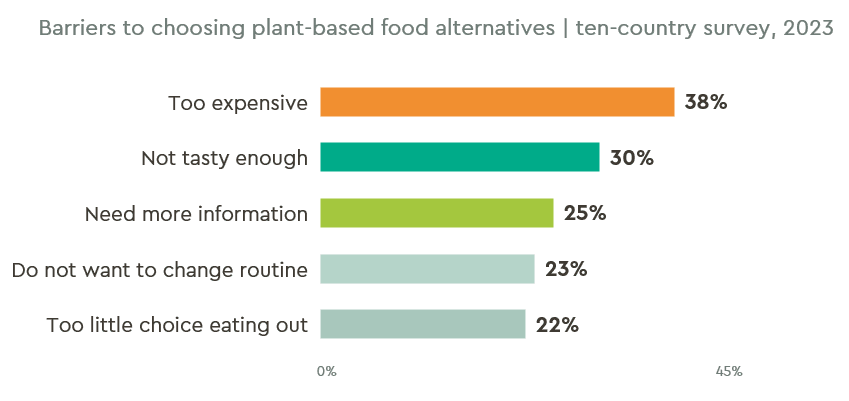
In the Smart Protein survey, 38% of respondents identified high prices as a barrier. Other frequently mentioned obstacles included insufficient taste (30%), a need for more information (25%), reluctance to change existing routines (23%) and limited options when eating out (22%).
These results highlight different challenges that require different responses.
A price promotion may encourage trial, but it does not address concerns about flavour, preparation or product suitability.
What does this mean for your business?
Identify the specific barrier before deciding how to respond. If price is the main concern, focus on value for money. If taste is holding consumers back, prioritise sensory quality. If consumers are unsure how to use a product, provide clear preparation instructions and recipe inspiration. For foodservice and QSR operators, menu availability and familiar applications also deserve attention.
The right solution depends on what prevents consumers from choosing the product.
5. Consumer priorities differ across European markets
European consumers do not necessarily assign the same importance to every product attribute.
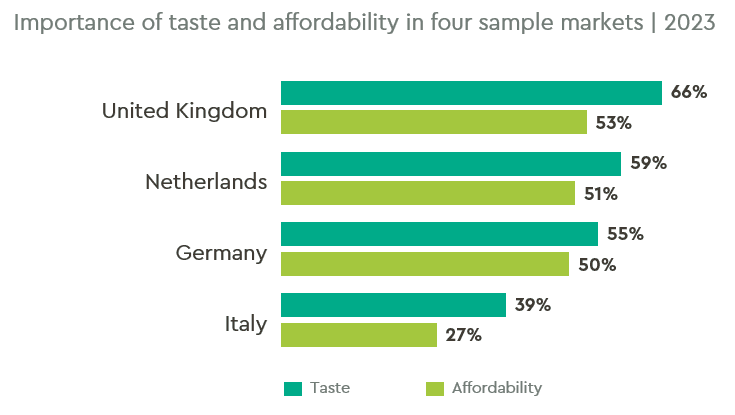
In the 2023 Smart Protein survey, taste was selected as an important factor by 66% of respondents in the United Kingdom, compared with 59% in the Netherlands, 55% in Germany and 39% in Italy.
Affordability showed a similar variation: 53% in the United Kingdom, 51% in the Netherlands, 50% in Germany and 27% in Italy.
These figures reflect the priorities reported by consumers in the survey. They do not measure which advertising messages perform best.
What does this mean for your business?
Develop a clear product proposition, but adapt how you communicate its benefits to individual markets. Depending on local consumer needs, your message might emphasise taste, value, nutritional properties or suitability for familiar dishes.
Test your positioning locally rather than assuming that one message will resonate equally across Europe.
6. Consumers expect more than a healthy image
Health plays an important role in how consumers perceive plant-based alternatives.
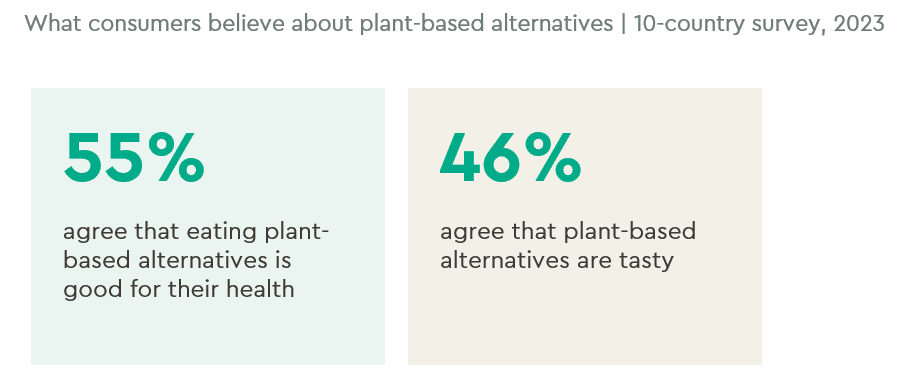
In the Smart Protein survey, 55% of respondents agreed that eating plant-based alternatives is good for their health. Meanwhile, 46% agreed that plant-based alternatives are tasty.
However, positive perceptions of a product category do not establish the nutritional quality of an individual product.
Protein content, fibre, saturated fat and salt can vary considerably between products.
What does this mean for your business?
Make nutritional benefits specific and transparent. Provide clear information about the nutritional composition of your products and communicate relevant benefits in a way that customers and consumers understand.
For food manufacturers and retailers, a strong nutritional profile can be an important consideration during product selection and development. Any nutrition or health claims must meet the applicable legal requirements.
Clear product information makes it easier to evaluate what a plant-based product actually offers.
7. Trust is linked to openness to food innovation
Innovation creates opportunities for new protein ingredients and production methods. Yet consumer acceptance is not guaranteed.
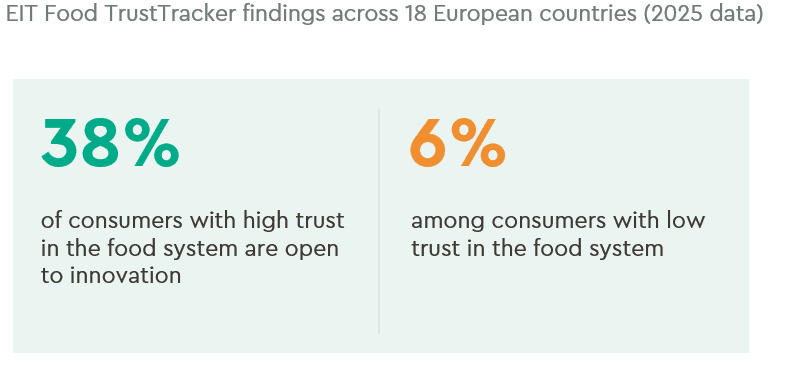
According to the EIT Food TrustTracker, 31% of European consumers surveyed were open to food innovation in 2025, compared with 28% in 2024.
Among consumers with high trust in the food system, 38% were open to innovation. Among those with low trust, this figure was just 6%.
The research identifies an association between trust and openness. It does not prove that increasing trust directly causes greater acceptance of innovative foods.
These findings concern food innovation broadly, not just plant-based meat alternatives.
What does this mean for your business?
When introducing unfamiliar protein ingredients, explain them in simple, accessible language. Help consumers understand what an ingredient is, how it is produced and what benefits it offers in the final product.
Focus on relevant product characteristics such as taste, texture, functionality and substantiated nutritional benefits.
Innovation becomes easier to understand when its value is clear.
8. Traditional proteins grow while meat-style products remain important
Plant-based innovation is not limited to products that imitate meat.
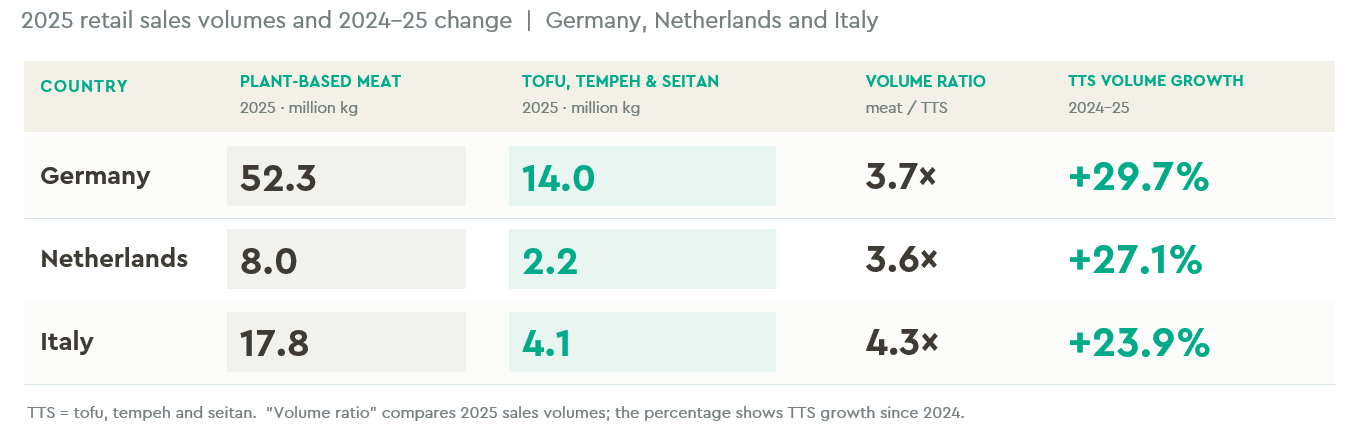
Retail data from GFI Europe shows strong volume growth for tofu, tempeh and seitan between 2024 and 2025 in several markets.
Sales volumes for these products increased by 29.7% in Germany, 27.1% in the Netherlands and 23.9% in Italy.
However, plant-based meat products still represented substantially larger retail sales volumes in these countries in 2025.
In Germany, plant-based meat volumes were approximately 3.7 times those of tofu, tempeh and seitan combined. The corresponding ratios were 3.6 in the Netherlands and 4.3 in Italy.
What does this mean for your business?
Both familiar meat-style alternatives and ingredient-led products deserve consideration.
The right choice depends on the eating occasion, target audience and desired product experience.
A recognisable burger or schnitzel format may suit one application, while an ingredient-led concept based on tofu or tempeh may suit another.
Start with the meal and consumer need. Then select the protein source and product format.
9. Home leads, but out-of-home consumption also matters
Where do European consumers eat plant-based alternatives?
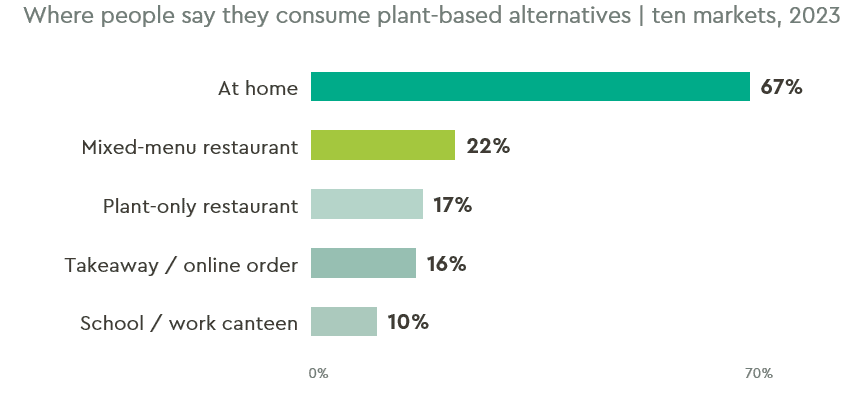
In the Smart Protein survey, 67% of respondents reported consuming them at home.
Other reported locations included restaurants serving both plant-based and animal-based dishes (22%), plant-based-only restaurants (17%), takeaway or online orders (16%) and school or workplace canteens (10%).
Respondents could select multiple locations. These percentages describe reported consumption locations, not sales or revenue shares.
The results show that home consumption plays a prominent role, while foodservice also forms part of the consumer experience.
What does this mean for your business?
Think beyond the individual product and consider the complete meal.
For retail, demonstrate how a plant-based product fits into familiar recipes. Clear preparation instructions and meal inspiration can help consumers understand its application.
For foodservice and QSR operators, consider menu compatibility, preparation requirements, consistency and cost per serving.
The best product concept is one that fits naturally into the meal consumers want to eat.
From consumer insights to product innovation
The European plant-based market presents opportunities, but there is no single formula for success.
Consumers differ across countries, purchasing habits vary and expectations around taste, price, nutrition and convenience continue to shape product choices.
For food manufacturers, retailers, foodservice operators and QSR chains, these insights provide a useful starting point for making informed decisions.
At Schouten Europe, we believe successful plant-based innovation starts with understanding both the consumer and the application.
Whether you are exploring new protein ingredients, improving an existing product or developing a plant-based menu option, a clear product brief makes a difference.
Consider six essential questions:
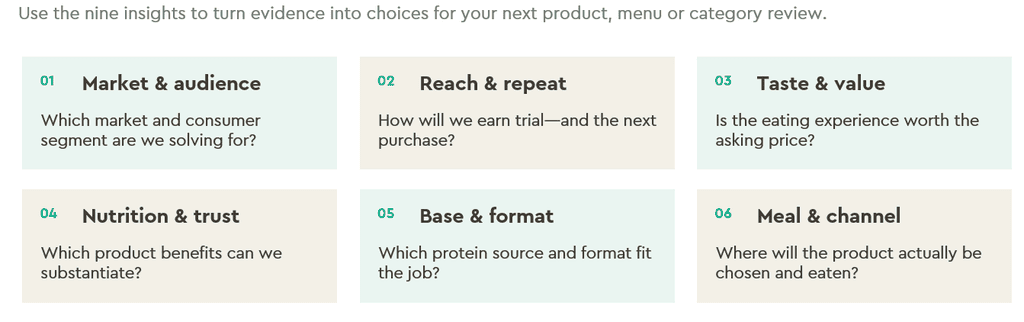
- Market and audience: Which market and consumer segment are you targeting?
- Trial and repeat purchase: What gives consumers a reason to choose the product again?
- Taste and value: Does the eating experience justify the price?
- Nutrition and trust: Which product benefits can you substantiate?
- Ingredients and formats: Which protein source and format best suit the application?
- Meal and channel: Where and how will consumers choose and eat the product?
By connecting consumer insights with product development expertise, you can identify relevant opportunities for your portfolio.

Boost your knowledge of the plant-based market!
Subscribe to our mailing and receive quarterly updates with exclusive market insights. You will also receive mailings with our latest plant-based innovations.
Join the hundreds of industry professionals who have already signed up before you.